
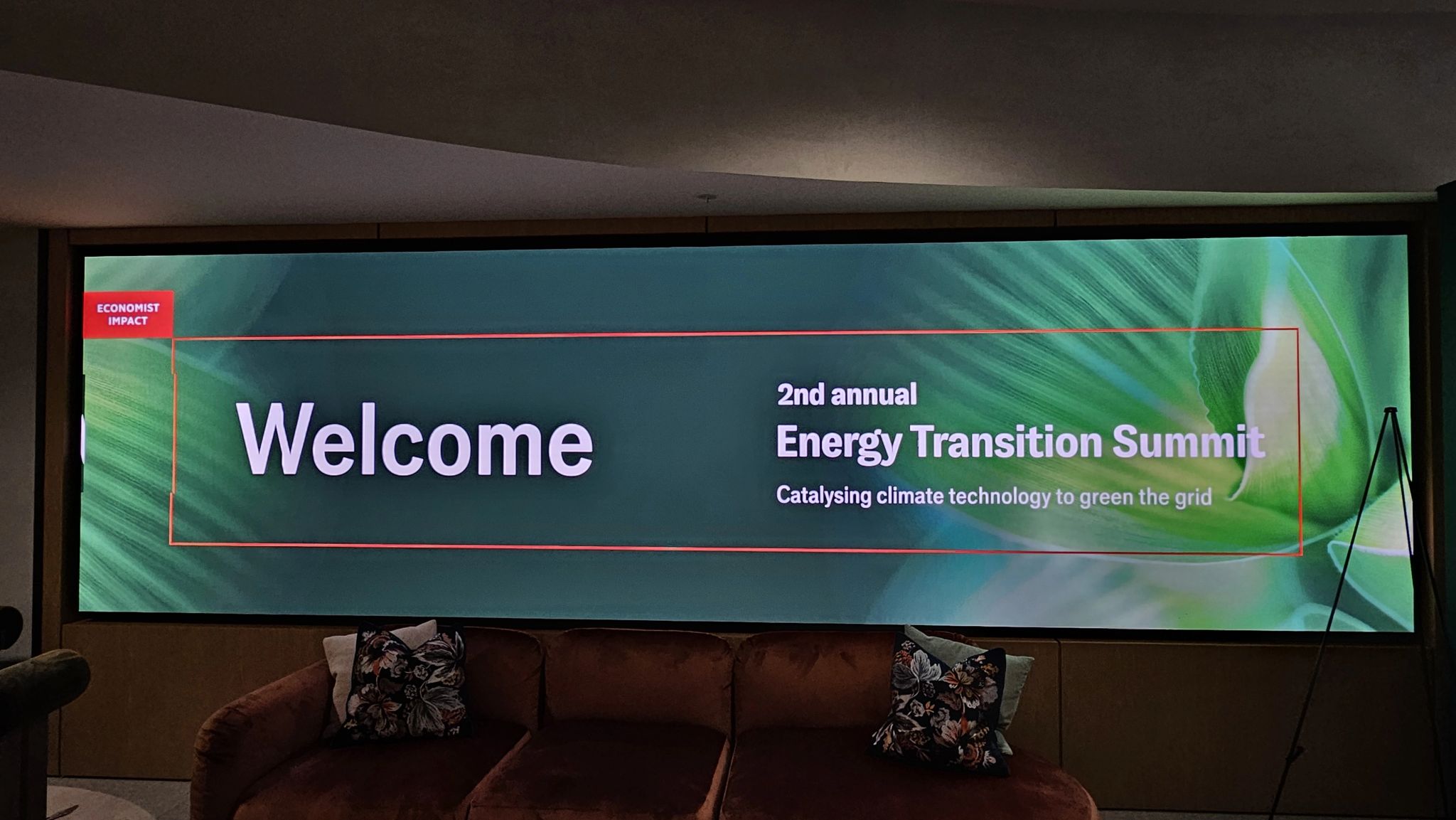
“Energy customers do not want to be day traders, they want hot showers and cold beers,” said Devrim Celal, Chief Marketing and Flexibility Officer at Kraken, speaking on a panel at The Economist’s 2nd annual Energy Transition Summit in London yesterday. It was the quote of the day for me.
There are probably 30 ways to trade in this market, Celal continued, but consumers only care about what that energy powers – the ‘utility’, The Economist might say.
Celal said energy suppliers should avoid complexity and offer customers simplicity and clear options. Consumer trust is the utility industry’s biggest challenge, he told the panel moderator.
Julien Lennertz, CCO at E.ON, amplified that point.
He enthused how Australia is a postcard from the future for Europeans. Widespread rooftop solar and granular data means many customers open their ‘bills’ anticipating cash-positive outcomes.
He praised the UK and Netherlands for their progress with smart meters but pinpointed low consumer trust as the barrier to getting more done, faster.
The discussion drove home the dilemma the industry faces: Show consumers the real complexity in the name of transparency or spare them the headache for the sake of convenience. The former leads to confusion and the latter to suspicion. It’s a problem.
You might think I pondered this key point for the rest of the conference. But nope, I got distracted. By AI. Just like everyone else…
First off, full credit to the team at The Economist for framing the AI conversations usefully – and addressing the double-edged sword of increased compute head on.
Will sky-high energy consumption in data centres be offset by AI efficiency gains in meatspace? It’s not clear. Jevon’s paradox did not go unmentioned.
One interesting idea is that AI training workloads are possibly the most flexible demand-side response: globally mobile and not time-critical. We can shift the compute workload to the most appropriate data centre and time – if that’s what we want.
On that point, John Cook, Senior VP at Mackenzie Greenchip, wondered if AI sucks the money away from the grid investments we need to actually bring that synthetic intelligence to bear.
But I missed the link back to the human dilemma. Can AI solve the conundrum of simplicity and transparency to win customer trust? Or, better yet, can AI-powered automation make that kind of marketing trivial?